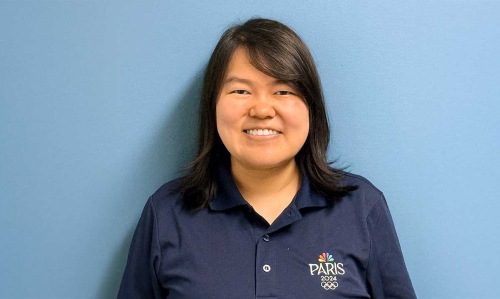
Lisa Bonner ’97 reflects on NYU Law and her life on the baseline with the Knicks

Lisa Bonner ’97
As an entertainment lawyer, strategist, and on-air media correspondent, Lisa Bonner ’97 has built a distinguished career representing artists and creators, media and production companies, athletes and start-ups—but even before she started practicing, she had a courtside seat on the action. While attending NYU Law, she was married to Anthony Bonner, a New York Knicks forward whose two-year stint with the squad included a thrilling seven-game series in the NBA Finals against the Houston Rockets in 1994. As she juggled her legal studies with treks to Madison Square Garden, Bonner was intricately connected to a time in which the Knicks—much like today—had captured the city’s imagination.
In this Q&A, Bonner recalls Knicks fever in the mid-1990s, talks about a lesson that she received from the late civil rights attorney and professor Derrick Bell, and reflects on the enduring sisterhood that she forged during one of the most celebrated eras in the history of New York City sports.
What brought you to NYU?
I began my career in investment banking, first at Lehman Brothers and then at M.R. Beal & Company, one of the nation’s oldest continuously operating Black-owned investment firms. As an analyst, I often found myself looking over at the bond lawyers leaving the office at 10 p.m., while I was still there at 2 a.m., sometimes literally waiting for documents to come off the printer. Although I enjoyed the analytical aspects of the work, I quickly realized I was not a numbers person and did not see myself building a long-term career in finance. Then I ultimately decided on going to law school.
At the time, my husband Anthony Bonner was playing professional basketball. When his career brought us to New York after he signed with the Knicks, I enrolled at NYU School of Law. That was literally one of the best decisions I ever made. I loved it there.
How did you and Anthony Bonner meet?
We are both from the same hometown of St. Louis, Missouri. I was living in Los Angeles and he was in Sacramento. But then I went home to visit my family after my grandfather became ill. Anthony happened to be visiting St. Louis at the same time, and we met through a mutual friend.
On the academic side, how was your experience at NYU Law?
I had some great professors. Derrick Bell was my Constitutional Law professor. Con Law can often feel like a collection of separate doctrines, cases, and tests. And for much of the semester, I couldn’t exactly see how the individual principles fit together. Professor Bell just had a remarkable way of connecting the pieces. And one day it all clicked: how the principles of individual rights, governmental powers, and equal justice are intended to interact to shape our democracy. It was one of those rare classes that fundamentally changed the way I thought about the law.
I also had Ronald Noble as my Evidence professor. He later went on to serve as Secretary General of Interpol, but even then he was an extraordinary teacher. Evidence is a highly technical subject, but he had a unique ability to make the rules of evidence engaging and relevant. He brought the subject to life in a way that made you want to pay attention and think critically to really understood the material.
At NYU Law, I just remember how collaborative it was and how everybody—the dean, the faculty, and other students—wanted to ensure that the law students had a great learning experience. To this day, I’m so happy that I can call myself an alum of NYU Law.
As Anthony played for a surging Knicks team, what did that mean for you while attending law school?
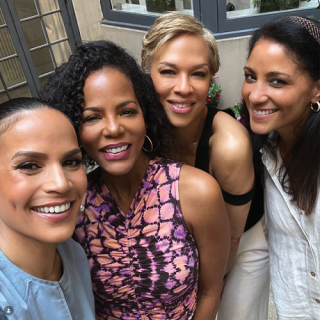
The friendship that I continue to have with Crystal [McCrary ’95, a writer and filmmaker who was married to former Knick point guard Greg Anthony], Rita [Williams-Ewing, an author who was married to former Knick center Patrick Ewing], and Tonya [Lewis Lee, a producer who is married to Knicks superfan, director, and NYU professor Spike Lee] were a huge part of my life then and now. The four of us were trained as lawyers and we bonded over being professionals. At the same time, we were having fun by attending the games and traveling during the playoffs. Our husbands didn’t hang out like we did. It’s not like we were hanging out because of them. It was the other way around.
In the mid-1990s, the Knicks were consistently playing in one spectacular playoff series after another. What do you recall about this period?
It was incredible, especially when you had a stake in the success. We were fans, but everything that was happening was a lot more personal for us. People ask me, “Are you still a basketball fan?” And I will tell anyone that I’ve watched enough basketball to last me three lifetimes. But there’s nothing like the Knicks and the electricity of the Garden. There’s no other energy like it. It’s everything that you think it is and you expect it to be.
I remember traveling to Houston [in 1994] for the NBA Finals. The excitement, the revelry, and the pressure of bringing a championship back to New York was all there. It all came down to game seven after the Knicks scrapped and fought their way to get there. But that last game just slipped away. And it was tough. Everyone was devastated. I know Anthony was. And it was very sad because getting to an NBA Finals championship can be a once-in-a-lifetime moment.
Today there is an image that has been popularized about women who are married to basketball stars, as depicted on reality television shows such as Basketball Wives. What do you think of this perception?
Crystal, Rita, Tonya and I have a chat group that Crystal named “The Originals” several years ago as a play on the concept. But the show features a small segment of hand-picked women for dramatic purposes. I work on scripted and unscripted shows. And I know how drama can be manufactured and plot twists set up for ratings purposes. The large majority of basketball wives aren’t out here living the life that is shown on television.
Back in our day, there was no social media. But we still had to deal with the paparazzi and the New York tabloids. And we were definitely living under a microscope in that sense. But when we were at the Knicks games, we always knew who we were. We’ve always been professional, beautiful, and smart people who carried ourselves with class and grace.
How did you break into entertainment law?
After law school, I was filing for divorce and decided to move back to Los Angeles to kind of get away and start fresh. So I started working at a civil litigation and bankruptcy firm. I was going out and meeting people in the industry. I was constantly getting offers. “Can you help me with this project? Can you help with that project?” So I quickly realized, if I didn’t get into entertainment law, I was going to be leaving a lot of money and possibilities on the table living and practicing in Los Angeles.
At one point, I was assigned to the bankruptcy case of a Grammy Award-winning artist. I had to conduct a 341 Meeting of Creditors and go through all of the documents to make sure that there were no fraudulent transfers and that everything aligned. Going through the documents, I had all of the entertainer’s contracts. So with that, I started teaching myself entertainment law. Soon after, someone who I studied with for the California bar exam called and offered me a job at a production company, the Digital Entertainment Network. It was literally one of the first companies that made productions for the internet. And that’s where I honed my skills as an entertainment lawyer. I was there for several years.
Later, I met attorney Londell McMillan ’90, also an NYU Law alum, at a conference for the Black Entertainment and Sports Lawyers Association. He saw me speaking on a panel and told me that he was looking for someone to open a Beverly Hills office for his firm with film, TV, and music experience. And I told him, “Well, hello—I do all of that.” And that’s how I started working with Londell. By that point, I was well on my way.
Are you still rooting for the Knicks today?
Oh, one thousand percent. I lived a very large portion of my life in New York City, before, during and after law school. My office is still there, my assistant is still in New York, and I pay taxes there. So even though I’m domiciled, as the lawyers like to say, in Atlanta, I’m in New York at least twice a month. Once a New Yorker, always a New Yorker. And plus, I was part of the franchise. I formed some of my deepest friendships as a “Knick Wife” that endure to this day. So, yes, I’m definitely still a Knicks fan.
This interview has been condensed and edited.