In Abrams Lecture, Maine Governor Janet Mills describes her fights in pursuit of justice
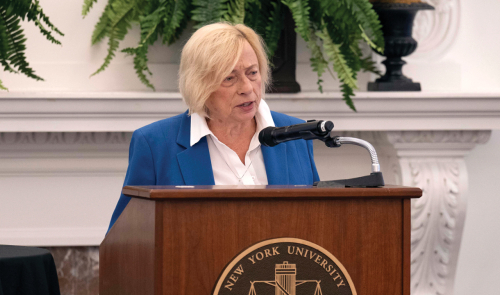
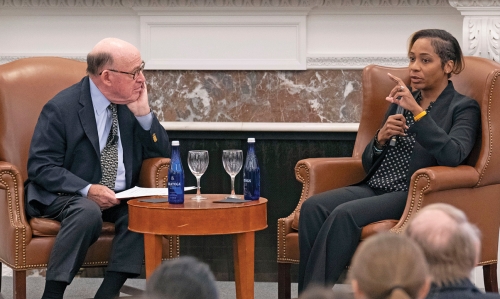
On September 8, Janet Mills, governor of Maine, exhibited the candor and focus on critical issues that have earned her a national profile as she delivered the 30th annual Attorney General Robert Abrams Public Service Lecture.
Introducing Mills, former New York attorney general Robert Abrams ’63 listed all her firsts: first woman district attorney in New England, first woman elected as attorney general of Maine, and first woman elected as governor of that state. Abrams lauded Mills’s success in dealing with the COVID-19 pandemic; providing free community college education; expanding Medicaid coverage; and advocating for LGBTQ rights, reproductive rights, and environmental issues.
“She’s not a cardboard cutout of somebody who’s in politics and in public office…. She is a real, genuine person,” said Abrams.
Mills began her speech by noting that she dropped out of college to go to San Francisco during the Summer of Love. But she went on to graduate from the University of Massachusetts Boston and from the University of Maine School of Law, and she served three terms in the Maine House of Representatives before becoming the state’s attorney general.
Mills asked the audience the same question that an apparition reportedly posed to the poet Percy Bysshe Shelley a month before his untimely death: “How long do you mean to be content?”
“That question should resonate in the mind of every student, every professor, every lawyer, every judge, every public official in today’s strange and difficult world,” she said. It had been on her mind, she said, as a law student witnessing the Watergate scandal and the end of the Vietnam War.
Recalling the widespread disregard for ethics and the rule of law among President Nixon and the lawyers in his administration, Mills said, “The judicial branch did stand up to the executive and did support the rule of law when it needed to…. The Constitution survived. And it was those who refused to remain content who changed the course of American history.”
Turning to the current era, Mills invoked the Trump administration’s series of executive orders targeting specific law firms, prompting nine of those firms to make deals with the administration to avoid retaliation. But four other firms, Mills said, fought the executive orders and prevailed in court.
She went on to describe increasing threats against federal judges after they are publicly disparaged by the administration, the purging of lawyers by the administration if they don’t fall in line, and a sharp uptick in unsigned and unexplained emergency orders from the US Supreme Court through its shadow docket.
Mills recalled her own experiences in which she refused to remain content. As Maine’s attorney general, she found herself in legal battles with then-governor Paul LePage over his attempts to block Medicaid coverage expansion under the Affordable Care Act and her refusal to defend his efforts in court; when she won the legal dispute, the governor retaliated by withholding funds from her office.
“My father told me it was important in life to stand up for people who couldn’t fend for themselves,” said Mills. “He would often say, ‘You can’t let bullies have their way. They never stop.’” That memory was in her mind, she said, during her visit to the White House in February 2025 when President Trump threatened to withhold federal funding unless she complied with his executive order banning transgender student-athletes from women’s sports. Her reply generated national headlines: “See you in court.”
Two months later, when the federal government stopped funding Maine’s school lunch program, Mills sued and prevailed, as she had done against LePage. Maine has joined more than 60 multistate lawsuits against the Trump administration in the past year alone, including one defending the right to vote by mail. (Six days after Mills’s lecture, the Supreme Court blocked the administration’s proposed restrictions on mail-in ballots for the upcoming midterm elections.)
Mills also spoke forthrightly about her defeats, including a recent high-profile one. In a question-and-answer session with the audience, she responded with a laugh when asked whether she would run for president: “I ran for US Senate for six months…. I think I’m done with that. It’s been a strange year in Maine, let’s just say. We had this guy [Graham] Platner come out of the blue…and he kind of took over. It was a media frenzy, he was in all the national media, and then he turned out to be kind of flawed.”
Setbacks or not, Mills said in her speech, “You must never simply remain content, but instead be inspired to make a difference, to solve problems, to be vigilant…. Whenever and however you do stand up, believe me, you will count for more than you think. Our country will stand taller, our country will be stronger, and the rule of law will thrive. I thank you, and I hope to see you in court.”