

Cassandre Davilmar ’13, Founder and Owner of Lakou Cafe
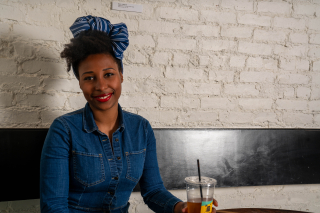
Cassandre Davilmar ’13, Founder and Owner of Lakou Cafe
Cassandre Davilmar ’13 is an AnBryce alumni and the founder and owner of Lakou Cafe, a Haitian-inspired restaurant and community hub in Crown Heights that celebrates culture, ownership, and access. After starting her career at Cleary Gottlieb Steen & Hamilton and later in investment banking at Moelis, Cassandre launched Lakou Cafe to create a space where business, culture, and community thrive together. Drawing on the analytical rigor and problem-solving skills she developed at NYU Law, she brings both structure and creativity to entrepreneurship, proving that sustainable business and social impact can coexist. For Cassandre, entrepreneurship is a form of advocacy and an invitation for others to see themselves as creators, owners, and investors in their own stories.
What made you decide to pursue a career in entrepreneurship/venture capital/startups after NYU Law?
After NYU Law, I initially followed a traditional path. I practiced at Cleary Gottlieb before becoming an M&A investment banker at Moelis. Both experiences taught me how capital, structure, and law shape opportunity. However, I also saw how often communities like mine were left out of those conversations. As a Haitian American woman, I have always been inspired by the legacy of self-determination within our culture and within historic Black communities like Weeksville and Crown Heights. Entrepreneurship became my way to continue that legacy and create something tangible that embodied culture, ownership, and access.
When I launched Lakou Cafe, I wasn’t just opening a restaurant; I was building a community hub that celebrates Haitian heritage, uplifts local talent, and proves that sustainable business and cultural impact can coexist. That journey has shown me that entrepreneurship is its own form of advocacy. It is a way to design systems that empower others to see themselves as creators, owners, and investors in their own stories.
How did NYU Law prepare you for this career?
My background in finance, accounting, and Africana studies from the University of Miami gave me an early understanding of both business systems and the social and historical forces that shape opportunity. NYU Law then built on that foundation. It taught me how to think critically, solve complex problems, and navigate uncertainty. Those skills have been essential in entrepreneurship. The analytical rigor I developed there helps me approach business challenges with structure and precision, while the school’s emphasis on social impact and equity shaped how I define success. Being part of such a diverse and dynamic community also reminded me that the law is not just about rules and systems, but about people and access. That understanding continues to influence how I build Lakou Cafe and how I think about creating opportunities within my community.
Why do you think lawyers find success in this career path?
I think lawyers can find success in entrepreneurship, but not automatically. Legal training sharpens critical thinking and attention to detail, which are important, but those same instincts can also make it harder to take the creative risks that business often requires. For me, stepping into entrepreneurship broadened my perspective. I learned how operations, people, community, and capital all work together to bring an idea to life. It pushed me to become more adaptive and open to uncertainty. Ironically, that experience has made me realize I would probably be a better attorney now than when I first practiced, because I understand the full ecosystem of what it takes to make a business function.
What was the biggest challenge you faced as a lawyer in this career path?
The biggest challenge I faced early on in my entrepreneurial journey was not leaning into my legal knowledge. It was a bit of a “shoemaker’s kids have no shoes” situation, where the lawyer wasn’t putting on her lawyer hat when she needed to. In the beginning, I was so focused on learning the areas I knew less about, such as human resources, marketing, and operations, that I sometimes took for granted the value of my own legal background in moments when it could have saved time, stress, and money. I quickly learned that I needed to prioritize legal issues and put structure around them.
Now I balance this by partnering with nonprofit organizations such as Start Small Think Big, which help me think through important legal matters that I might have pushed aside to handle more urgent business concerns. That experience reminded me that strong legal foundations are just as essential to growth as creativity and hustle.
What is the most important thing students should do while they are still in law school to prepare themselves for a career in entrepreneurship, in venture capital, or at a start-up?
The most important thing students can do is stay curious and expose themselves to experiences outside of the traditional legal path. Take classes in business, entrepreneurship, and leadership, but also spend time learning from people who are actually building things. Go to networking events, volunteer with startups, or join clinics that support small businesses or founders. And just as important, network with your peers. Many of your classmates may have family or friends who are entrepreneurs, and those relationships can open unexpected doors later on. Relationships are everything in business. The connections you build now can become collaborators, clients, or partners in the future. Law school can sometimes make you think success only looks one way, but the truth is that legal training gives you a tool kit you can use in almost any setting. The more you explore how that tool kit applies in different contexts, the better prepared you’ll be to create something meaningful after graduation.
What was the most important lesson you learned in your career thus far?
The most important lesson I’ve learned is to trust myself and stay rooted in my vision, even when the path isn’t clear. Entrepreneurship is full of uncertainty, and there will always be outside opinions about what you should or shouldn’t do. I’ve learned that clarity comes from movement. You don’t have to have everything figured out to take the next step.
I’ve also learned that community is everything. No one builds alone. The people who believe in your vision, show up when things get hard, and celebrate the small wins with you are what make the journey sustainable. I’m deeply grateful for the community that continues to support Lakou Cafe, whether by visiting the cafe, ordering catering, or sharing our story. You can learn more at www.lakoucafe.com or follow along on Instagram or TikTok @lakoucafe.
---
This alumni feature will appear in our November 2025 newsletter. Stay up to date on everything EVC by signing up for our newsletter here.