

Camille Zhu ’20, Co-founder, ThunderDay Games
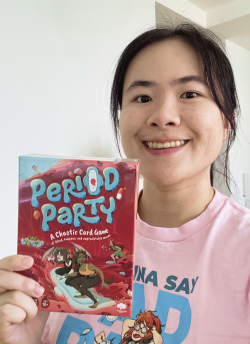
Camille Zhu ’20, Co-founder, ThunderDay Games
Camille Zhu ’20 is the co-founder of ThunderDay Games, an indie game studio. While working full-time as legal counsel at a tech startup, Camille has spent the past three years developing her first game, Period Party, a menstruation-themed strategy card game aimed at breaking the stigma around menstruation. Having long cared deeply about women’s rights and engaged in legal advocacy in this area, Camille sees Period Party as a form of advocacy, though in a different and perhaps unexpected way: using the power of play to challenge period taboos and make menstruation easier to talk about.
Camille’s legal training has helped make this bold idea feasible. From navigating entity formation, contracts, and IP protection to assessing and managing risk in product and business decisions, her legal experience has been invaluable in building and running the business. At the same time, being a business owner and game designer has taught Camille a different side of risk-taking. She has learned that sometimes it is worth making the crazy, risky, and perhaps not commercially “smartest” decision to create something she believes should exist.
What made you decide to pursue game development?
I am a gamer, but I never imagined developing a game myself. In the summer of 2023, my partner and I were daydreaming about game ideas based on “cyclical phases,” like day and night. The first idea that came to me was: “On my period and not on my period.” I realized how wild it sounded, but I couldn’t let it go.
As someone passionate about women’s rights, I saw how impactful a game about menstruation could be. Our early playtests and events confirmed that people needed a more approachable way to engage with periods and break down the stigma. I became convinced that a game like this should exist. If so, why not us? That strong belief in the cause gave me the motivation to learn everything else along the way and turn a wild idea into a real game.
When did you become passionate about advocacy around women’s health? Can you share more about how you’ve engaged with legal advocacy in this area?
I’ve cared deeply about women’s rights for as long as I can remember, and that advocacy has taken many forms. Before law school, I interned with an organization supporting survivors of domestic violence, and during law school, I interned with the Domestic Violence Unit at San Francisco District Attorney’s Office. After law school, I also volunteered as a guest speaker on legal issues related to online sexual harassment. Outside of formal legal work, it can be as simple as speaking up in everyday interactions or hosting a women’s book club at my company. I’ve always hoped that, in whatever way I can, I can contribute in some small way to advancing women’s rights and equality.
To me, menstruation is not only a women’s health issue. The stigma around periods is deeply connected to broader attitudes toward women and their bodies. That’s why bringing Period Party into board game conventions and communities that are still predominantly male has felt particularly meaningful. Sometimes simply putting an unapologetically period-themed game on the table feels like advocacy in and of itself.
Did your education at NYU Law influence the way you think about ThunderDay Games?
My legal education has equipped me with skills that have been incredibly useful in building ThunderDay Games. Being able to navigate entity formation, contracts, and intellectual property is a real advantage. More broadly, law school trained me to research unfamiliar topics, identify the right questions, and find my way forward even when I start with limited knowledge.
My legal background also gave me more confidence to start a business. There are so many unknowns when you’re building something for the first time, and knowing that some of the complicated parts were already within my comfort zone gave me a lot of reassurance. It made taking that first step feel much more manageable.
What has building ThunderDay Games taught you outside of your role as a lawyer?
The first adjustment has been going from advising the person taking the risk to actually being that person. As in-house counsel, I’m used to laying out the risks as frankly and thoroughly as I can and then letting the business decide what to do. With ThunderDay Games, I can identify all the risks, but at the end of the day, I have to decide which ones I’m willing to take. Knowing every reason something could go wrong and still choosing to do it is definitely challenging!
The second adjustment has been learning that not everything needs to be “right.” A contract may be relied on for years, so there is a reason to be careful about every word. But a social media post that may get 30 views probably doesn’t need the same level of perfection. Building and marketing a product has taught me to judge how much time and precision something actually deserves, and more importantly, to be comfortable letting it go when it’s “somewhat” enough for what it needs to do. It sounds simple, but honestly, I still struggle with it.
What is the most important thing students should do while they are still in law school to prepare themselves for a career in entrepreneurship, or at a startup?
As both legal counsel at a startup and founder of a game studio, I think understanding and drafting contracts is one of the most important legal skills you can develop. I’m extremely grateful that I took Professor Naveen Thomas’s Contract Drafting course and later participated in the Business Transactions Clinic with him. Those experiences really taught me the foundations of contract drafting that I still benefit from today, on both sides of my career.
Separately, I think law school is a wonderful time to build a basic understanding of areas that may be difficult to learn from scratch later. For example, even if you have no intention of becoming a tax lawyer, taking Income Tax can teach you how to approach the tax code and understand the basics you may encounter when running your own business. When you’re just starting out, you probably won’t have the budget to hire a lawyer every time you have a question, so having some foundational knowledge in a few relevant legal areas can go a long way!
----